The Tools of Survival
When I started my illustration career, I was quite the ambivalent 3D artist; I honestly couldn’t stand the medium. I thought it was all pretty ugly. Yet this was in the late 1990s, and at that time it was basically all that clients wanted.
Given that 3D was the only work I could get, I was determined to figure out a way to actually embrace the medium. As I continued to work in 3D, it grew more and more apparent to me that as a 3D artist I was much closer to being a sculptor and photographer than a traditional pen-and-pencil illustrator. That’s ironic, given that the final “product” I deliver reads as and actually is an illustration — it’s an image/drawing/rendering of something on a flat, two-dimensional space (that is, printed on paper or seen on a screen). But the process that leads to this “illustration” is much closer to photography and sculpture than traditional drawing.
I’ll explain with some screengrabs of a recent project. This was for Dr. Daniel Dumesic, a UCLA physician at the forefront of PCOS (polycystic ovary syndrome) research. Turns out, PCOS, which affects 1 in 10 cis women of reproductive age, was an adaptive evolutionary step that protected females from the environmental vicissitudes of hunter-gatherer societies, such as famine.
I suggested we show a hypothetical female with PCOS in two different scenarios: one of a hunter-gatherer, and the other in a modern-day work environment. Same woman, same caloric intake, just different weight distributions because of the energy requirement being so different between the two worlds. Here’s the final illustration I sent:
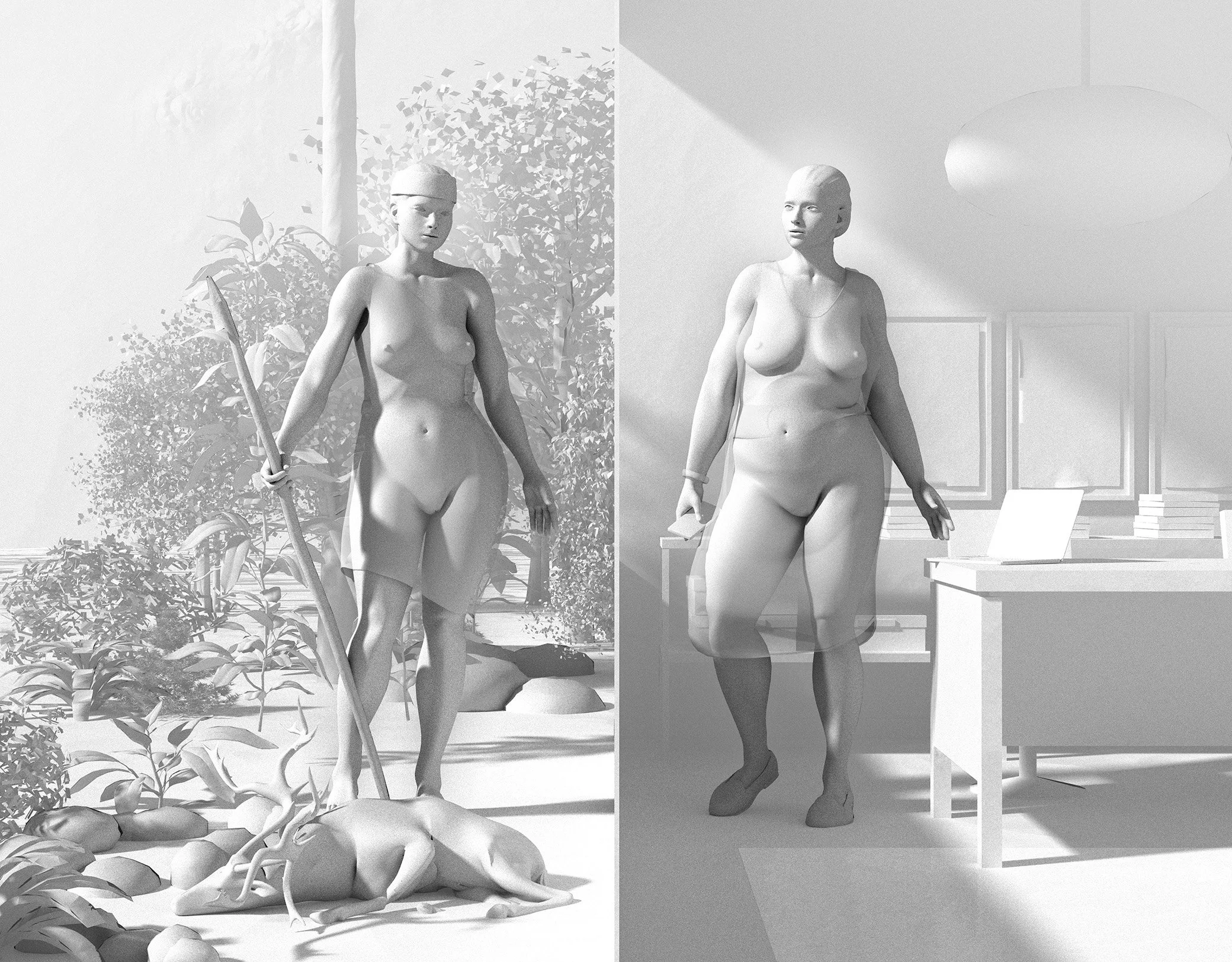
I would like to think the final piece reads as an illustration. But behind the scenes, it’s in many ways unrelated to traditional illustration. I actually built, or “modeled,” all of the elements in this illustration in 3D space. Yes, a digital 3D space on a computer, but a 3D space nonetheless. Here is a screengrab of a couple of the views of the 3D scene I built shown from different angles, in its pre-rendered state:
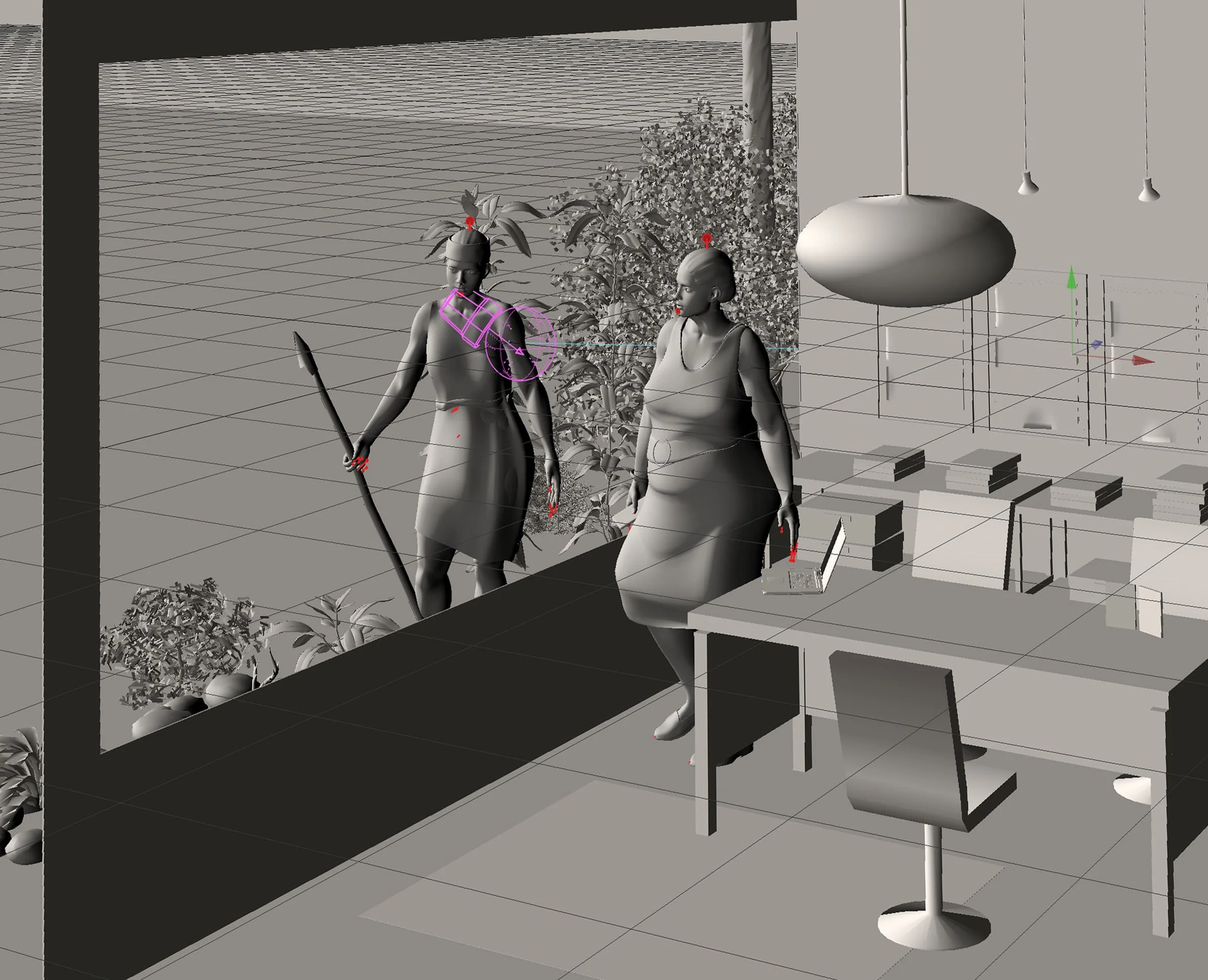
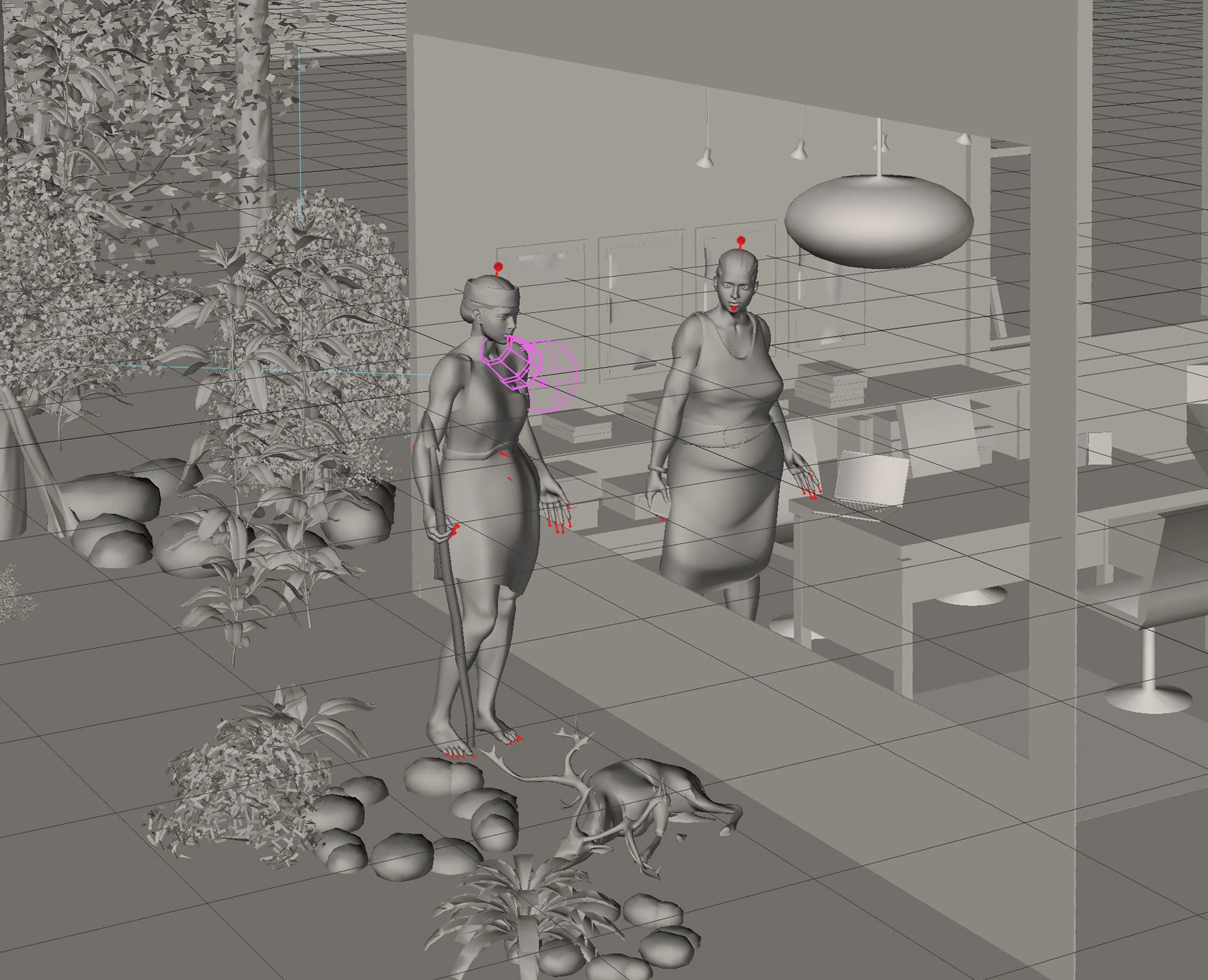
What you are looking at are shapes and things I “sculpted” in 3D software. I had an internal visual idea of how the composition would come together, and using this idea as a North Star, I crafted a scene in virtual 3D space. Again, the principles of sculpture all apply here. For instance, these models can be viewed from all different angles. Once I loosely set up the scene, I work with a camera (highlighted in blue) and lights (yellow):
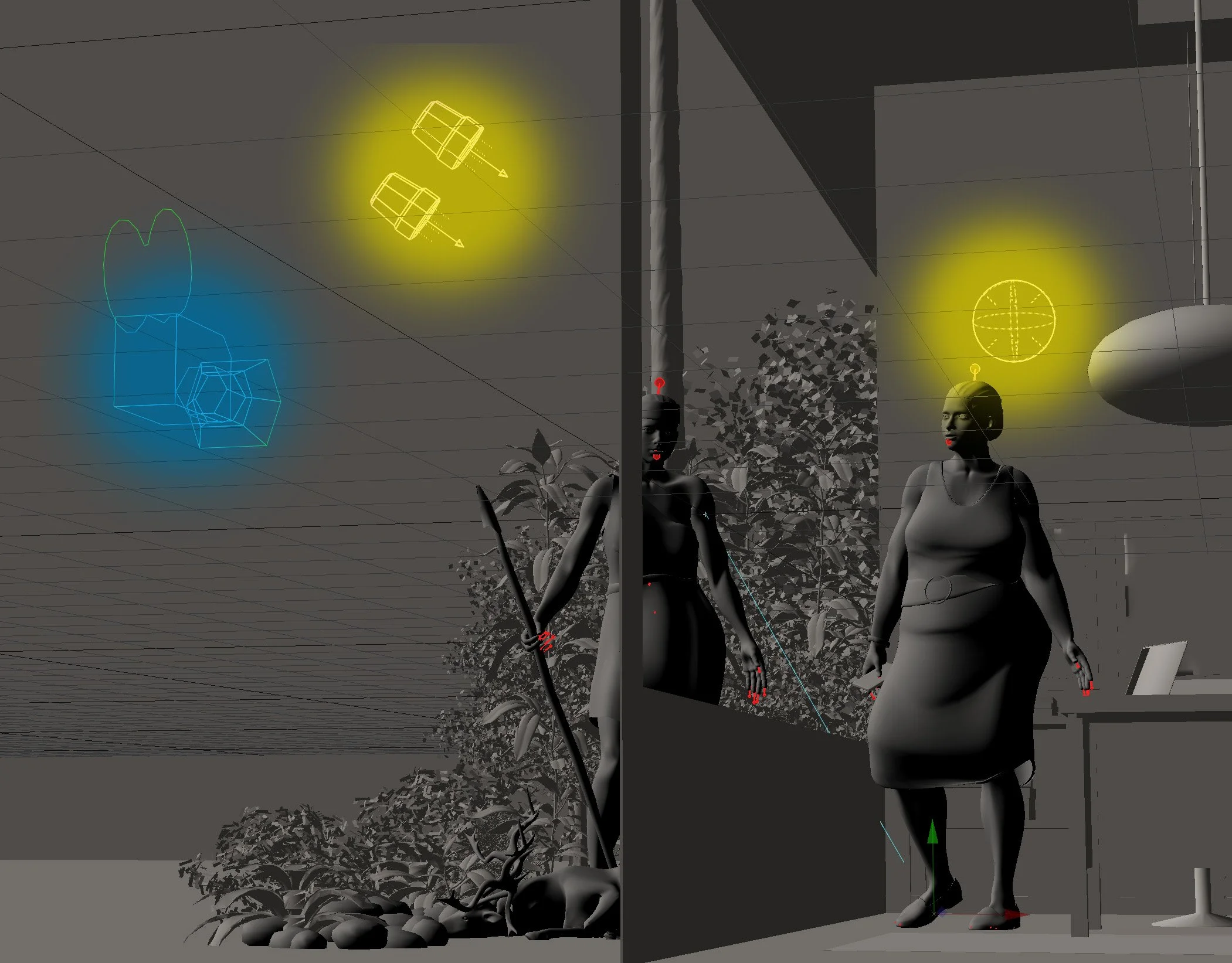
Below is the pre-rendered, unlit state of the piece, looking through the camera I set up.
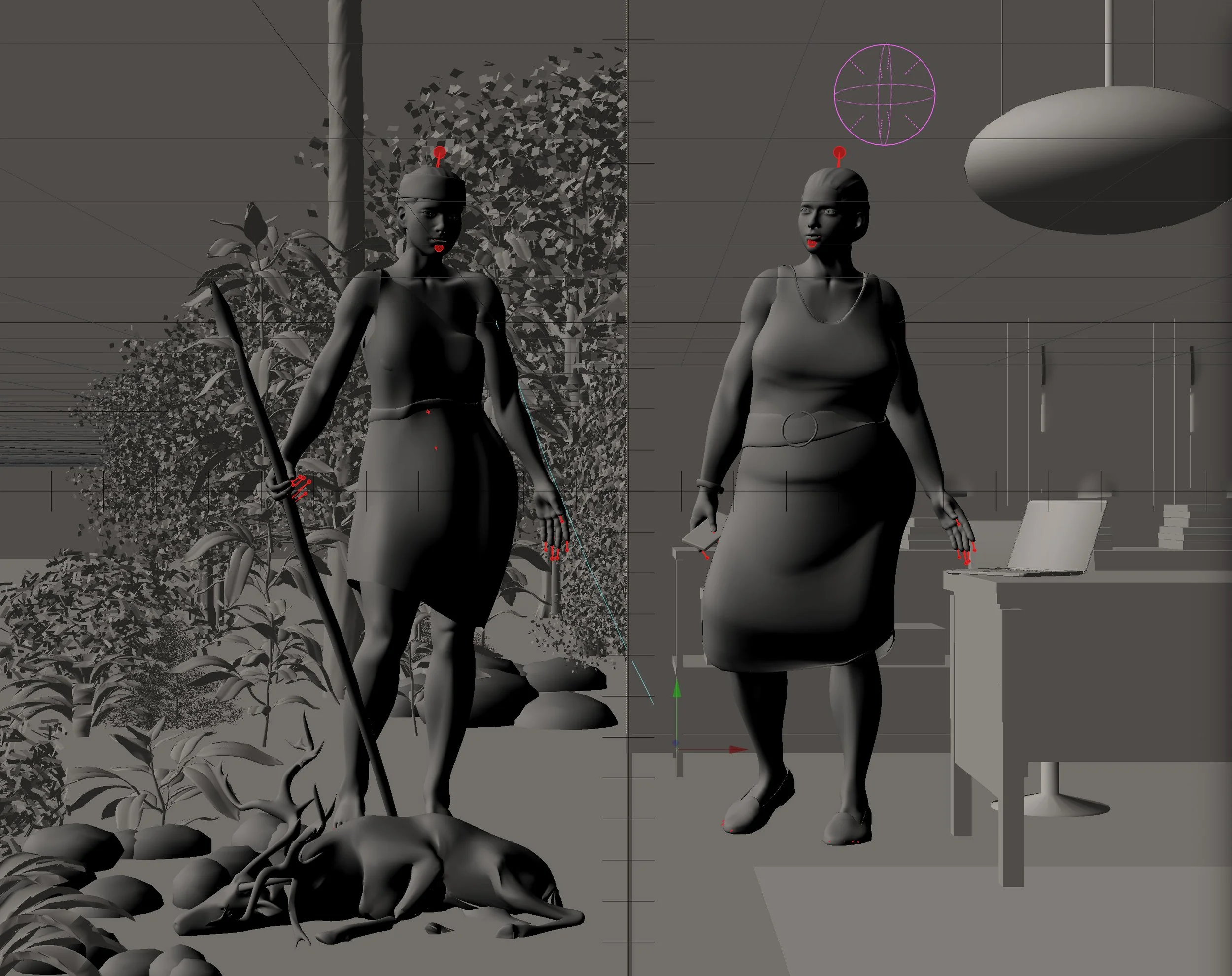
The camera position is critical. I’ll show you a view using the same camera but from a lower angle and using a wider-angle lens. The models are exactly the same, they’re in the exact same position, but because of this different vantage point and more extreme focal length, the feeling changes considerably:
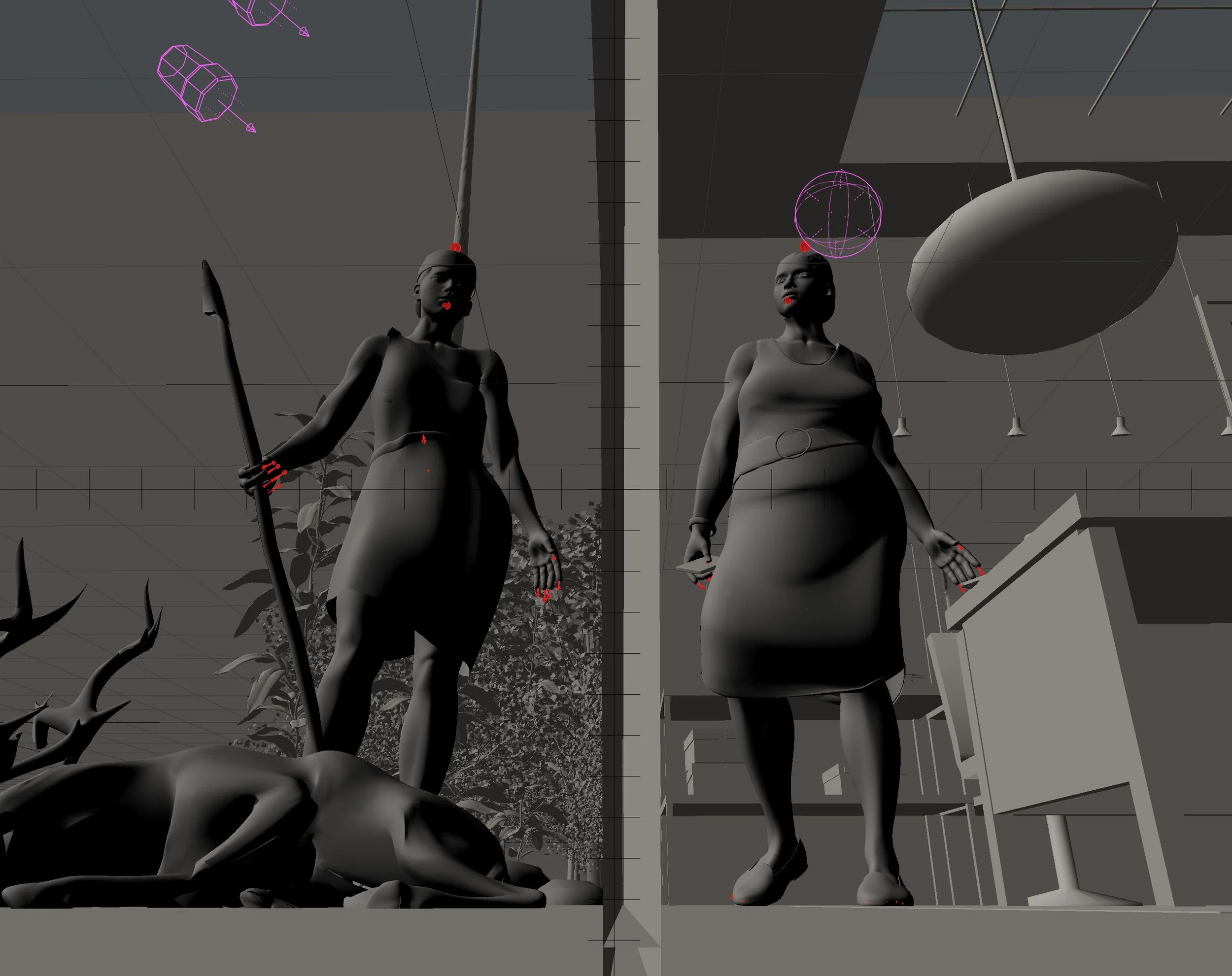
Again, same models, same positioning of models in the scene, just two different camera angles. And that makes a huge difference. For instance, notice the deer at the foot of the hunter woman. In the top piece, she looms over it and is larger. But in the foreshortened view with a lower angle, the deer is optically nearly the woman’s size as a result of the perspective distortion. The point of this illustration is to compare the same body but in different scenarios, so if the deer is looming too large, I am working against the intent of the communication.
Now let me show you how lighting can drastically change a piece. Below are two renders of this scene. The top one is using the lighting setup you saw in the final, and in the image below, I have rearranged the lighting, lighting the subject from other angles:
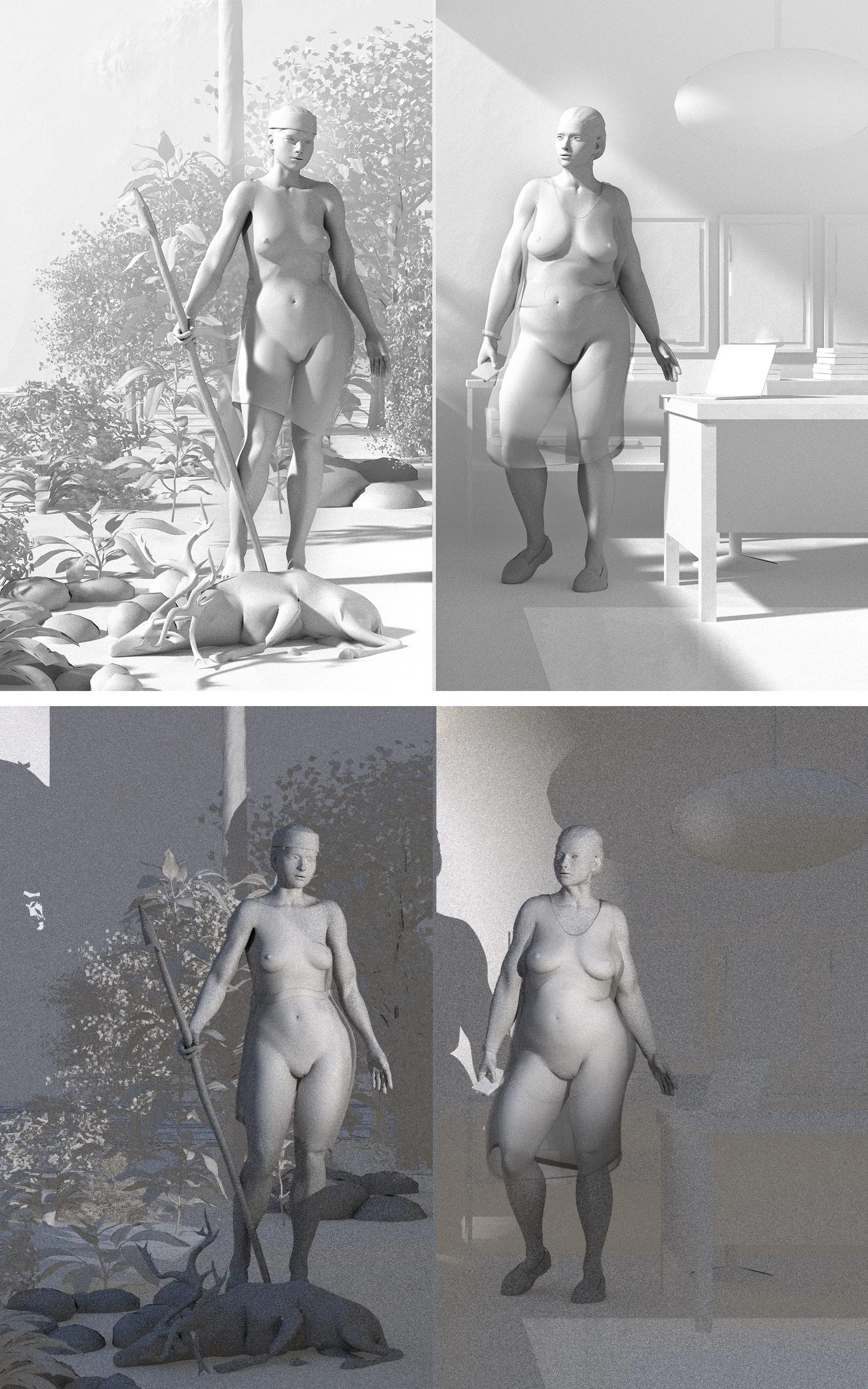
Again, same models, same scene, same camera, but with a different lighting setup, the tenor of the illustration changes dramatically. But given the purpose of this piece is to inform and explicate, all of the lighting, camera angles, etc., must be subservient to the information that is needed to be conveyed. So even though the lighting in the second image may be more dramatic or “cool,” it really makes no sense in the context of being a scientific illustration that is concerned with showing a clear comparison of two bodies.
I realized I was thinking of the two sides of the illustrations as a woman looking at a reflection of herself in a different world. So I started contemplating how to bring that mirroring into the illustration. Here’s a diagram:
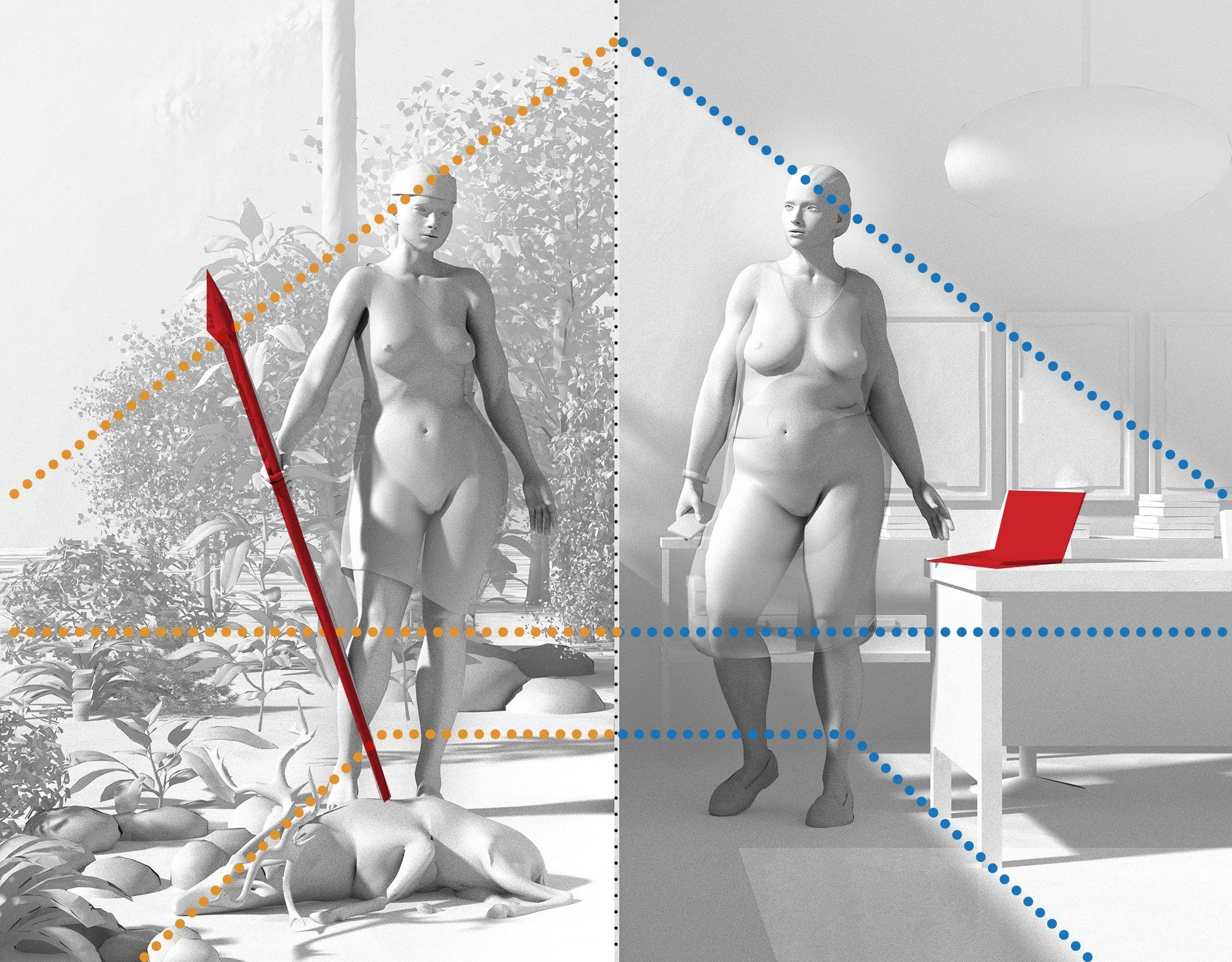
In her right hand, the hunter holds a spear, with which she killed the deer at her feet. This is her tool of survival; she hunts game in order to keep a high enough caloric intake to survive. The woman in the office gestures with her left hand (the “mirror” hand of the hunter’s) to the laptop on a desk: her tool for survival in a modern technological world, where she must earn an income to pay for food, shelter, etc.
I attempted to mirror the woodland area and the office space visually by using diagonals that meet at the top of the illustration: the office wall is illuminated by sunlight streaming through the (implied) window, and in the woods, the foliage in the background reaches diagonally up to the top.
In a sense, these were all two-dimensional concerns, in that I was thinking about shapes and light being presented on a flat screen or printed page. But the manner in which these shapes were achieved was through manipulating the direction of lights and the shadows they cast, positioning objects in three-dimensional space in order to get this design.
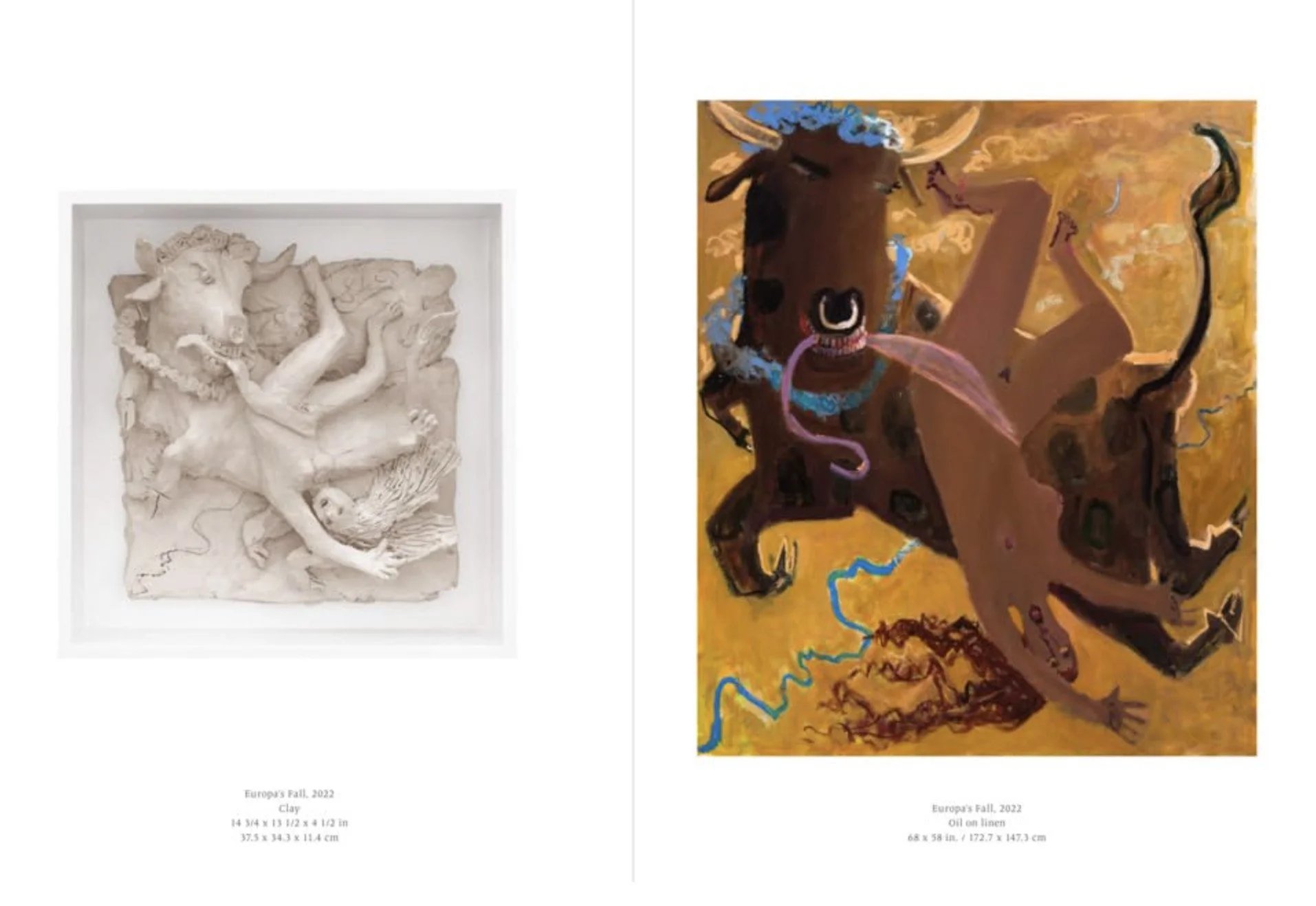
This is nothing new. In essence, what I’m doing is building maquettes, which artists have been making as studies for their paintings for centuries. In fact, Kyle Staver, one of my favorite painters, does this: